
Trump's Iran Encore Sinks Nasdaq 2%, Oracle's Capex Tab Comes Due
The day had a script and Trump tore it up before lunch.

A cooler-than-expected CPI print should have given the bulls something to work with, but the President went on TV, promised to hit Iran “really hard” again, and the bid disappeared from anything with an AI logo.
The Nasdaq lost 2%. Super Micro Computer dropped 28% on a $7 billion share issuance. Oracle beat its quarter and then watched its capex line do all the talking after the close.
And Amazon, almost as an afterthought, opened up a freight business that gutted the entire trucking complex in a single press release.
The Rundown
A softer core CPI print was overrun within hours by fresh Trump threats against Iran, and the AI complex took the brunt of the unwind
A major AI-server name announced a $7 billion equity raise to fund hardware purchases against a $39 billion order book, and the market punished it brutally
The marquee hyperscaler report after the bell beat on the top and bottom line but the capex disclosure stole the show, sending the stock down hard in late trading
Amazon’s move into less-than-truckload freight sent the established carriers down 5-7% on the day
A Tape That Forgot About The CPI Inside An Hour
The Dow Jones (DJI | ▼1.87%) gave up almost 2%. The Nasdaq (COMPX | ▼1.98%) lost a clean 2%. The S&P 500 was somewhere in between, but the read across the broader market was the same as it has been for most of the last week, tech is doing the selling and the rest of the tape is along for the ride.
The morning actually started constructively. Core CPI rose 0.2% month over month, below the 0.3% economists penciled in. That sounds small until you annualize it, which is exactly the math the Fed is doing. Headline inflation moved up to 4.2% year on year, the highest reading in three years, but the month-over-month softness was the part the bulls wanted to lean on. They didn’t get to lean for long.
Trump went on TV mid-session and laid it out cleanly: “We have hit them hard yesterday, and we are going to do it again today.” That single quote did more to the Nasdaq than the CPI print had managed in the opposite direction. The trade behind the screen is straightforward, every additional week the Strait of Hormuz stays disrupted is another week of fragile oil supply chains, another week of AI capex math under pressure, and another week the IPO calendar has to sweat. The President is signaling that week is coming.
Chips, Round Three
The semiconductor names took the third real beating of the week. MICRON TECHNOLOGY INC (MU | ▼4.70%) lost almost 5%. BROADCOM INC (AVGO | ▼5.12%) gave up over 5%. ADVANCED MICRO DEVICES (AMD | ▼4.86%) fell roughly the same.
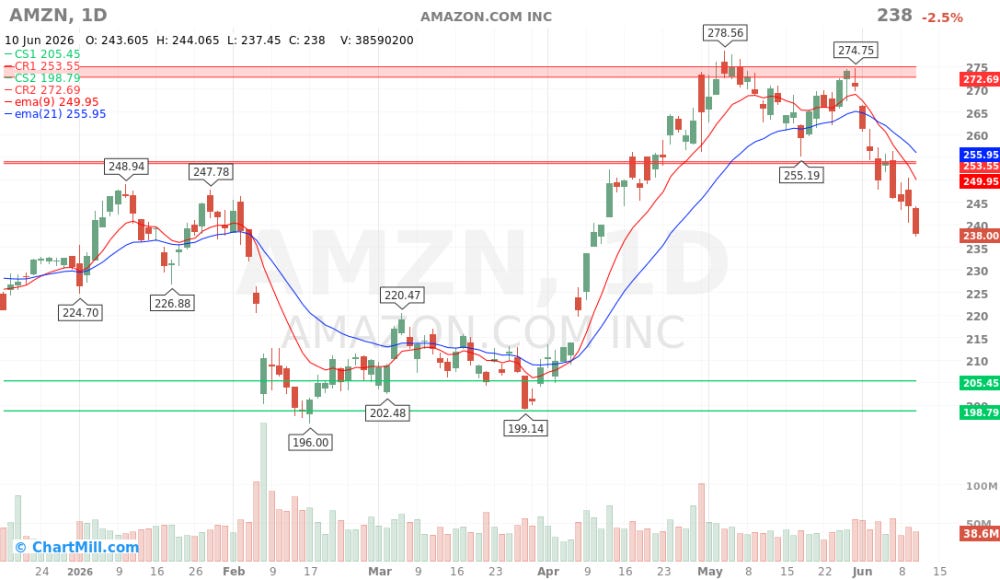
QUALCOMM INC (QCOM | ▼6.92%) was the worst of the marquee names with a 7% drop. The AI-platform tier wasn’t much better,
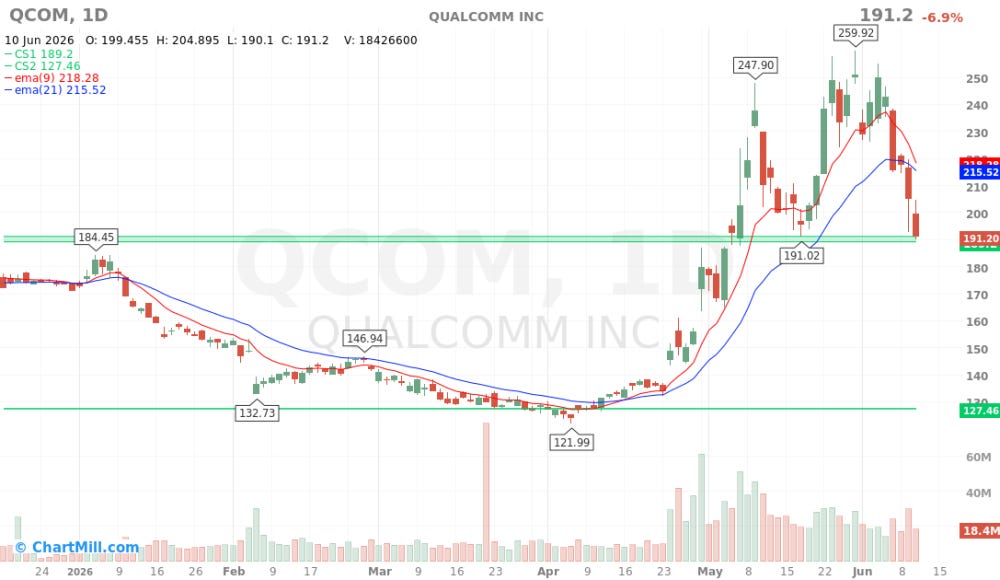
ALPHABET INC-CL A (GOOGL | ▼2.16%), AMAZON.COM INC (AMZN | ▼2.53%) and META PLATFORMS INC-CLASS A (META | ▼2.33%) all closed down more than 2%.
The standout was SUPER MICRO COMPUTER INC (SMCI | ▼27.98%), which dropped 28% on a single disclosure. The company is raising $7 billion through a mix of common equity and equity-linked instruments to pay for the hardware components it needs to fulfill what it described as roughly $39 billion in AI-server orders on the books.
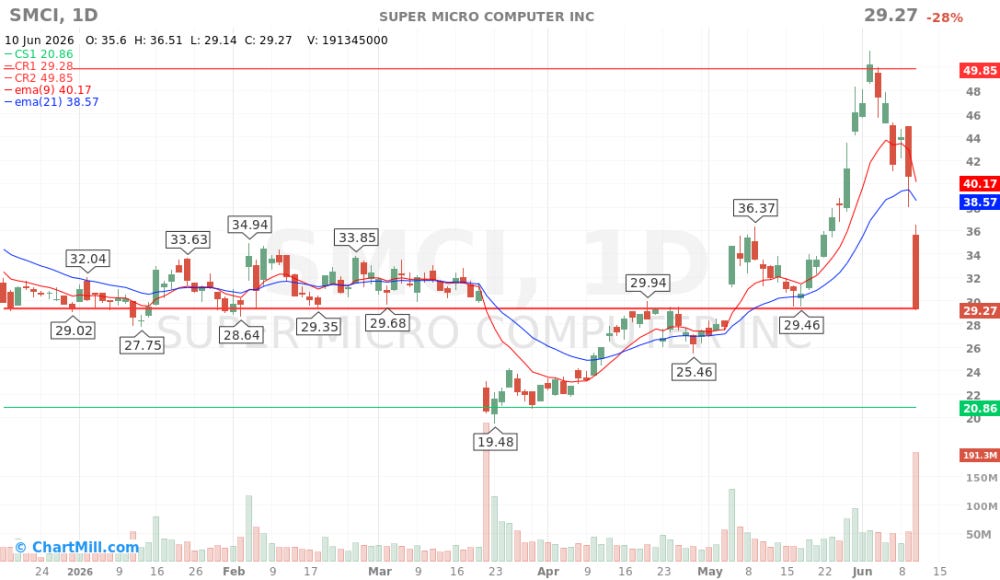
The order number is staggering. The funding plan is the problem. A dilution at this scale, in this kind of tape, against an order book that is real but still has to convert, is exactly the equity-supply concern that has been weighing on the entire complex for two weeks now.
The lesson keeps repeating. The AI buildout works the math only if the equity market keeps absorbing the supply at acceptable prices. Every name that comes to the tape - and they are coming weekly now - chips at that assumption. Friday’s selloff, Tuesday’s selloff, and now Wednesday’s selloff are all variations on the same trade. The unwind isn’t done.
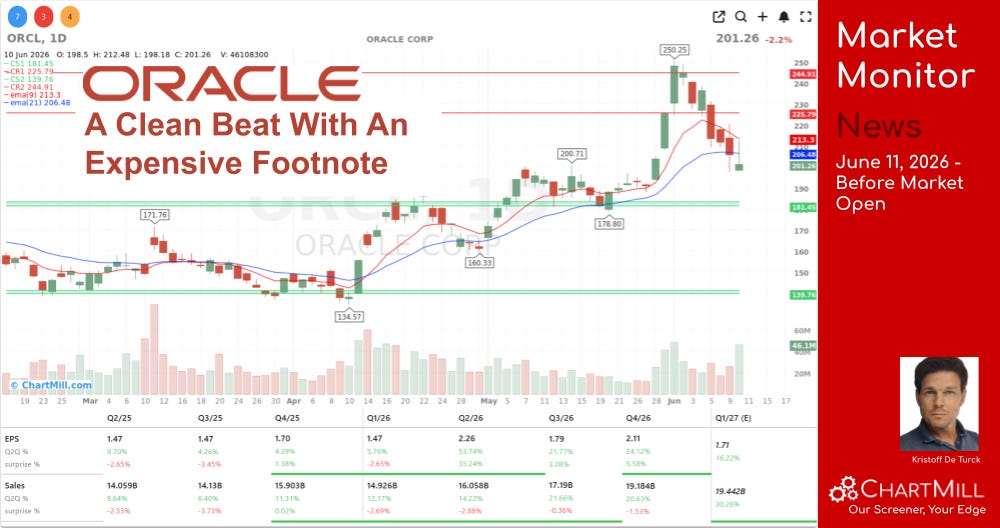
Oracle: A Clean Beat With An Expensive Footnote
ORACLE CORP (ORCL | ▼2.21%) reported after the close and on paper it was a strong quarter.
Fiscal Q4 revenue came in at $19.2 billion, up 21% year on year and a hair ahead of the $19.1 billion consensus.
Earnings per share landed at $2.11, up 24% and well ahead of the $1.97 the Street was looking for.
The cloud infrastructure number was the real anchor, data center revenue grew 93%, beating the 91% analysts modeled.
The contracted-but-unbooked revenue line was the part Larry Ellison wanted you to focus on. Remaining performance obligations sat at $638 billion at quarter-end, up $85 billion from Q3, which itself had been up $30 billion sequentially. The AI demand pipeline is real, and Oracle has a written claim on a sizable chunk of it. Management reiterated the $90 billion revenue target for fiscal 2027 and raised the EPS guide for next year to $8.05.
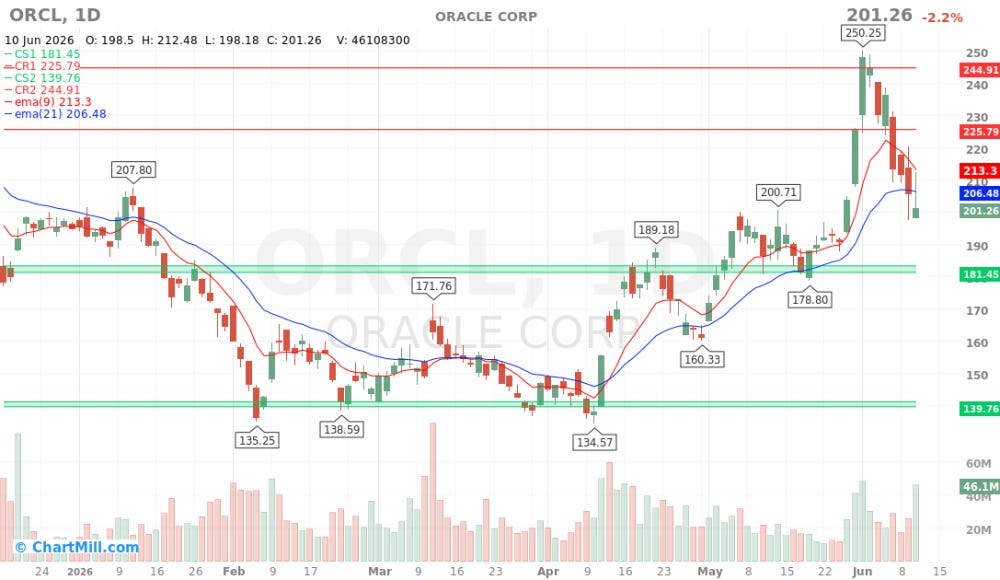
So why was the stock down 7% in after-hours trading?
Capex. Q4 capital expenditure came in at $15.9 billion, which pushed the full-year number to $55.7 billion. Oracle had previously guided to $50 billion.
That overshoot, by itself, would have been digestible, CFO Hilary Maxson explained it as a timing pull-forward, with projects originally slated for fiscal 2027 brought into the current year. Co-CEO Clay Magouyrk added the obvious follow-up point: accelerating capex is exactly the job when revenue can be recognized sooner.
The 2027 number is where the math gets uncomfortable. Oracle is guiding to roughly $70 billion of net cash capex for the next fiscal year, plus another $20-25 billion in prepayments. Free cash flow in the year just closed was negative $23.7 billion. The company is essentially front-loading every dollar it can to capture the demand window, and the equity market is starting to ask the question that has been asked of every hyperscaler in the last six weeks: when does the return on this capital actually show up, and what does the gross margin look like on the way there.
Maxson telegraphed the answer most analysts didn’t want to hear. Gross margins will compress this year because depreciation lands before the contracted revenue ramps to full run-rate. Once data centers operate at full contracted volume, margins should “recover quickly.” That’s a fair operational point. It’s also the kind of statement that requires investors to take management at its word for several quarters before the numbers can validate it. In a tape this jumpy, that’s a lot to ask.
The longer-term capex line is, in my read, the entire AI-equity story compressed into one company. The demand is there. The contracts are signed. The order backlog is real. But the dollars it takes to fulfill that demand are enormous, the free cash flow is negative, and the equity issuance windows across the entire complex are getting more crowded. Oracle reported well and the bears still found their angle within three minutes. That tells you where positioning is.
Amazon Walks Into Freight, And The Freight Stocks Walk Out
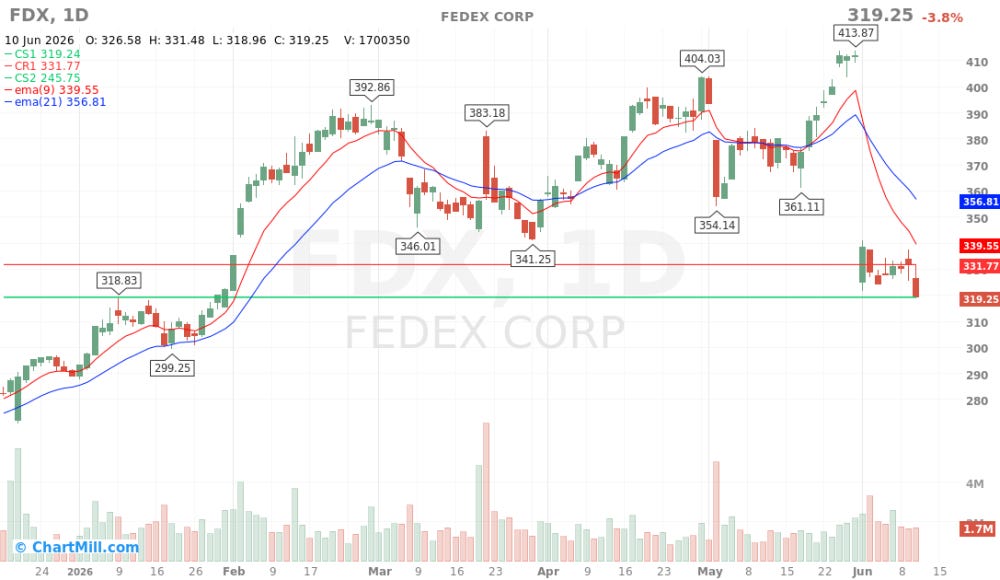
The under-the-radar story of the day belonged to Amazon. The company announced it would open up its less-than-truckload network - its system for handling partial trailer loads - to customers outside its own fulfillment footprint. In other words, Amazon is now a freight company.
The carriers took it the way you would expect. FEDEX CORP (FDX | ▼3.77%) lost 7%. OLD DOMINION FREIGHT LINE (ODFL | ▼5.14%) fell 5%. XPO INC (XPO | ▼4.97%) dropped 5%. SAIA INC (SAIA | ▼3.25%) and ARCBEST CORP (ARCB | ▼4.65%) gave up 3-5%. The market clearly read this as a structural threat, not a small-margin product launch.
I’d be careful before extrapolating too far. LTL is a notoriously hard business, service density and network topology are everything, and the incumbents have spent decades building both. Amazon will figure it out eventually because Amazon figures things out eventually, but a single press release does not collapse a moat.
The reaction in the share prices, though, tells you how much of these companies’ valuations were sitting on the assumption that Amazon was never going to show up. That assumption just died.
The Other Side Of The Tape: Gas Stations And Pancakes
A couple of nice old-school beats. CRACKER BARREL OLD COUNTRY (CBRL | ▲22.56%) ripped 23% after delivering Q3 EPS of 29 cents on $797.4 million in revenue, against a FactSet consensus that was modeling a 48-cent loss on $776.7 million.
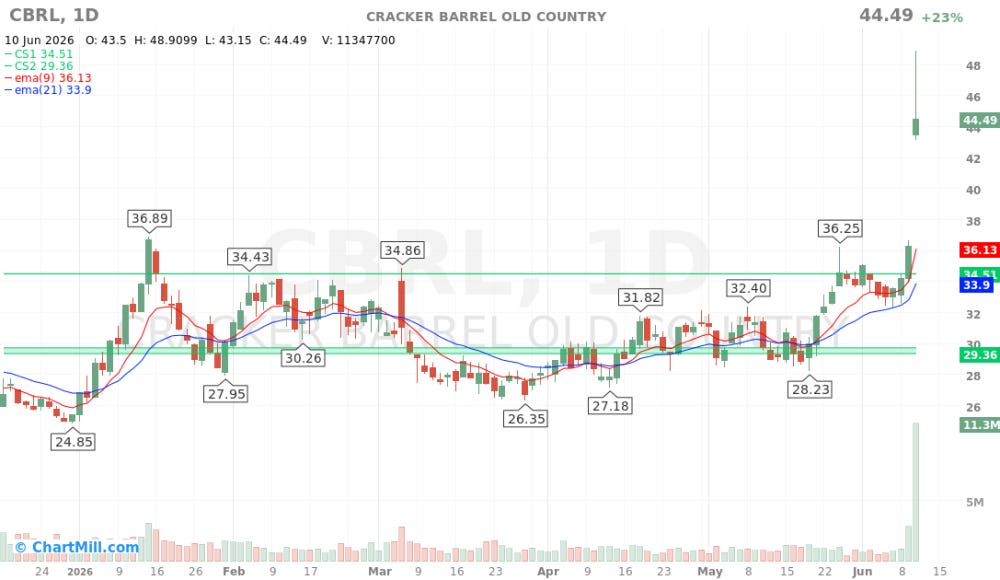
That is a significant operating delta, a positive earnings surprise of 77 cents per share against a loss expectation is not a beat, it is a reset. Management also raised full-year revenue and adjusted EBITDA guidance.
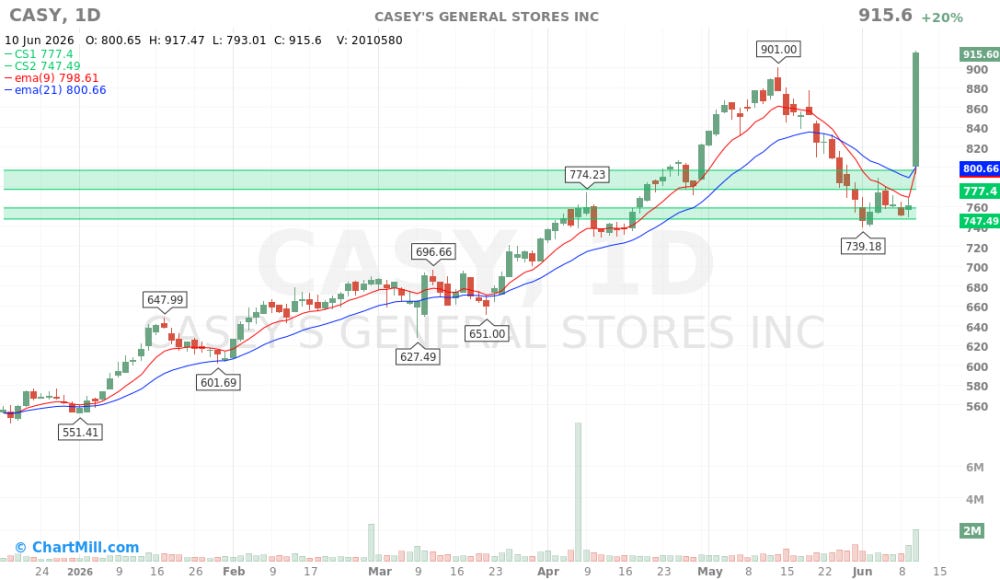
CASEY’S GENERAL STORES INC (CASY | ▲20.29%) also gained more than 20% on a strong quarter and a fiscal 2027 EBITDA growth guide of 8-10%.
Higher fuel margins and stronger prepared-food and beverage sales did most of the work. Gas station economics are unglamorous and underappreciated, and Casey’s is in the small group of operators who turn that into a real moat.
A few gaming names also caught a bid. DRAFTKINGS INC-CL A (DKNG | ▲4.35%), RUSH STREET INTERACTIVE INC (RSI | ▲4.46%), SUPER GROUP SGHC LTD (SGHC | ▲2.77%) and PENN ENTERTAINMENT INC (PENN | ▲5.56%) all closed higher after DraftKings management told a Jefferies conference that prediction markets are not cannibalizing their core business in a material way, and that the World Cup will be a meaningful traffic catalyst in the back half of the year.
That is the right framing, the prediction-markets threat has been overhyped on the short side for nine months now, and the operators are starting to push back with specifics.
Oil Up, Gold Down, And A Bond Market That Didn’t Flinch
WTI for July delivery closed up 2.1% at $90.03. US crude inventories dropped another 7.2 million barrels last week? the seventh consecutive weekly decline.
The supply picture is genuinely tight, and Trump’s TV appearance, in which he claimed the US has been secretly smuggling oil through the Strait of Hormuz to keep prices below $100, did not exactly reassure anyone about the legal or operational realities of regional energy flows. Whether the smuggling claim is real, embellished or fully made up, the President is openly admitting that Hormuz is not normalized? that’s the part traders are pricing.
Gold dropped 3% on the day, which dragged the miners with it. ANGLOGOLD ASHANTI PLC (AU | ▼7.06%) lost 7%. GOLD FIELDS LTD-SPONS ADR (GFI | ▼5.52%) fell almost 6%. NOVAGOLD RESOURCES INC (NG | ▼5.29%) and HARMONY GOLD MNG-SPON ADR (HMY | ▼3.99%) each gave up 4-5%. HECLA MINING CO (HL | ▼3.17%) lost 3%.
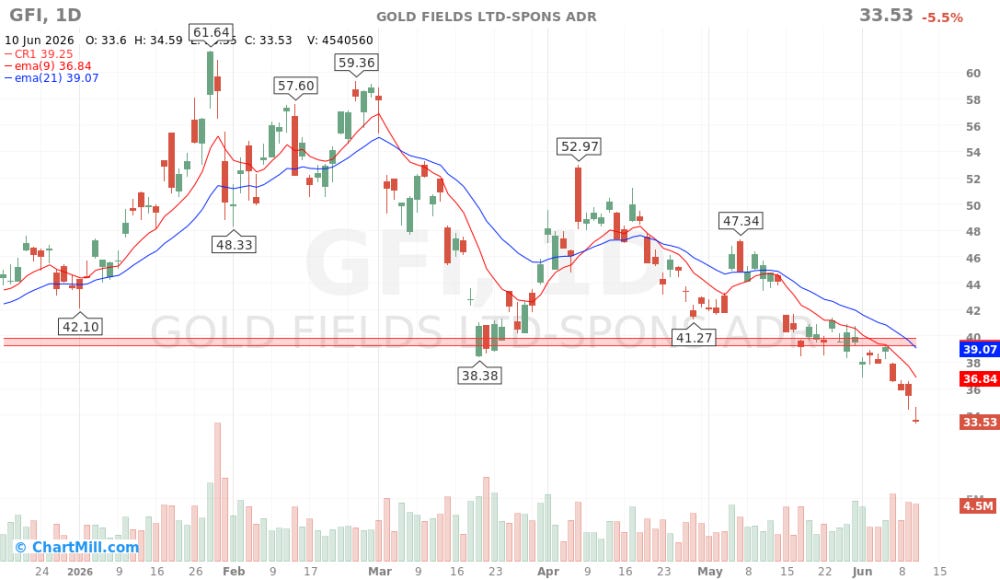
The miners trade on operating leverage to the gold price, and a 3% spot move is enough to take 5-7% off the equity. Nothing structurally changed in the gold thesis, this was positioning, not news.
The 10-year yield closed essentially flat at 4.54%. Euro/dollar barely moved at 1.1543.
That is interesting given how much narrative noise the day had. The bond market is refusing to take a strong view on either the Iran situation or the CPI. That neutrality is itself information.
Consumer Behavior Is Starting To Show Up
One quiet data point worth flagging. CHEWY INC - CLASS A (CHWY | ▼2.06%) reported and management told the market that consumers are pulling back on branded products and shopping more carefully on items they don’t strictly need. The stock is now down more than 40% year-to-date.
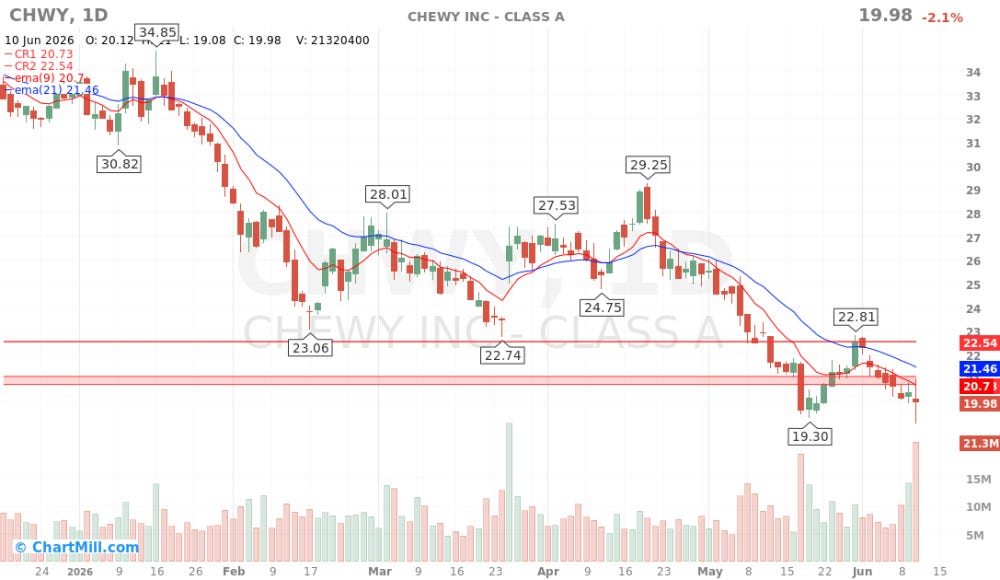
Pet care is one of those categories that, in a consumer-discretionary downturn, is supposed to hold up. People don’t unsubscribe from their dog. So when a pet retailer flags trading down and discretionary cuts, it suggests the consumer-spending squeeze is finally reaching the categories that usually go last. That isn’t a recession call. It is a sign that the inflation we just saw print at 4.2% is doing real damage at the household level, even before the next round of Iran-related headlines tests the energy supply chain.
Bottom Line
Wednesday was the third selloff in five sessions, and the pattern is starting to harden.
A constructive macro print gets overrun within an hour by a single Trump TV appearance, the AI complex gives back another 2%, equity issuance keeps stacking up, and the hyperscaler that everyone wanted to see beat earnings ended up creating a fresh capex problem.
Oracle’s print isn’t bearish on its face - the order book is real and the demand is real - but the dollars required to deliver on it are not getting any smaller, and the market is starting to pay attention to that side of the equation.
The next twenty-four hours have a lot to clear. Oracle’s post-print reaction continues into Thursday morning. Trump’s Iran rhetoric is one tweet away from re-pricing oil.
SpaceX prices Friday. I’d keep position sizes tight, stay away from chips on weakness until the issuance calendar thins out, and pay attention to the consumer signals, they’re starting to compound.
ChartMill Market Desk - Kristoff
With regard to the stocks discussed in the article above; the author owns individual shares in Nvidia.
This daily update is prepared by ChartMill for informational purposes only and does not constitute investment advice. Always do your own due diligence before making investment decisions.
👉 This article is also available at ChartMill.com.